


Oct
Why Do I Get Back Pain at the Office?
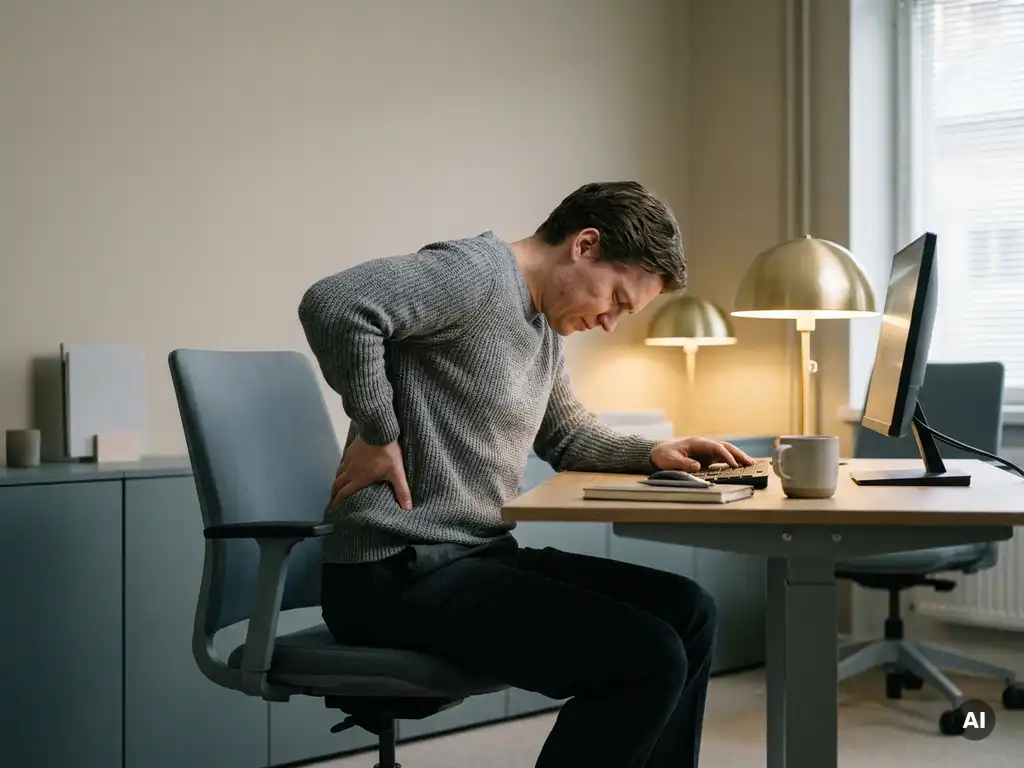
Back pain in the office almost always develops from prolonged sitting in a static posture, which increases pressure on the spine and overloads the muscles surrounding your back. The combination of immobility, a forward-bent posture, and muscle tension is the most common cause. In this article, we answer the most frequently asked questions about office-related back pain and what you can do about it.
What happens to your spine when you sit for a long time?
When you sit for a long time, the pressure on your intervertebral discs increases significantly compared to standing or moving. Your spine loses its natural S-shape, the lumbar vertebrae flatten, and the intervertebral discs experience uneven loading. Over time, this leads to pain, stiffness, and reduced mobility.
In an ideal standing posture, the vertebrae distribute the load evenly across the intervertebral discs. As soon as you sit down, and especially when you lean forward toward a screen, that load shifts to the front of the discs. The back of the intervertebral disc is then relatively unloaded, but the muscles and ligaments at the rear of the back have to work harder to support the trunk.
After a few hours of sitting, those muscles become fatigued. They are under constant mild tension, without the alternation of movement they normally receive. At the same time, blood flow to the intervertebral discs decreases; these discs have no blood vessels of their own and depend on movement to absorb nutrients. Prolonged sitting is therefore not just a matter of posture, but also of reduced tissue absorption and increasing pressure in the spine.
Which muscles and structures cause back pain during office work?
In office work, the most commonly involved structures are the lumbar vertebrae and their surrounding muscles, the hip flexors, the upper back, and the neck. Muscles such as the iliopsoas (hip flexor), the erector spinae (back extensor), and the trapezius (neck-shoulder) become chronically overloaded or weakened by prolonged sitting.
The hip flexor is one of the most underestimated causes of lower back pain in office workers. When you sit for hours at a time, the iliopsoas shortens. Upon standing, this shortened muscle pulls the lumbar vertebrae forward, causing an exaggerated hollow back and placing pressure on the facet joints. This often feels like a nagging pain low in the back, sometimes radiating toward the buttocks.
At the same time, the deep stabilizing muscles of the trunk, such as the multifidus and the transverse abdominal muscle, weaken from lack of active use. These muscles are normally responsible for the fine control of the spine. When they no longer perform their function properly, the spine adopts a less stable position, increasing the risk of complaints.
Similar processes occur in the upper back and neck. Prolonged forward projection of the head toward a screen, also known as the “text neck” pattern, increases the effective load on the cervical spine. This can lead to neck pain, shoulder pain, and tension headaches.
Why doesn’t an ergonomic chair always help with back pain?
An ergonomic chair reduces the load on your spine, but does not solve the fundamental problem: prolonged sitting remains harmful, regardless of how good the chair is. Back pain from office work rarely has a single cause and is rarely just a matter of furniture.
A good chair supports a better sitting posture and distributes weight more favorably. But if you sit for eight hours a day, the hip flexors continue to shorten, the stabilizing muscles continue to weaken, and the intervertebral discs remain under pressure, even if you are sitting upright. Ergonomics is a tool, not a solution.
Moreover, people often unconsciously compensate their posture throughout the day. You start out sitting upright, but after an hour of work you slump again. This is not a lack of discipline, but a signal of muscle fatigue. The muscles that actively support your posture are simply not strong enough to maintain this for hours without variation.
What does help in addition to a good chair:
- Getting up and moving regularly, preferably every thirty to forty-five minutes
- Alternating between sitting and standing, for example with a sit-stand desk
- Targeted exercises to stretch the hip flexors and strengthen the core
- Awareness of your posture, particularly the position of your head relative to your shoulders
How do you know if your office back pain needs chiropractic care?
Back pain that disappears after a night’s rest or a few days of reduced movement generally does not require specialist care. But when complaints persist for more than two to three weeks, recur regularly, or are accompanied by radiation into the legs or arms, it is advisable to seek professional help.
Signs where chiropractic care may be beneficial:
- Back pain that persists despite rest and movement
- Pain that radiates into the buttocks, legs, or arms
- Recurring complaints that keep returning to the same location
- Morning stiffness that lasts longer than thirty minutes
- Limited mobility in the neck or back during daily activities
- Headaches associated with neck tension or poor sitting posture
Chiropractic care focuses on the structural causes of complaints, not just on relieving symptoms. When vertebrae or joints are not moving optimally, this can affect the nerve communication between the brain and the body. By realigning the spine, the underlying cause of the complaint is addressed rather than merely suppressing the pain temporarily.
What does a chiropractor do for back pain caused by office work?
A chiropractor begins with a thorough analysis of your posture, mobility, and complaint pattern to determine which vertebrae or joints are not functioning optimally. Targeted adjustments are then made to reposition the spine, restore mobility, and reduce pressure on intervertebral discs and nerves.
For complaints arising from office work, attention is often directed to the lumbar vertebrae, the transition between the thoracic and lumbar spine, and the cervical spine. Depending on the findings, the chiropractor may use various techniques, including targeted spinal manipulation, mobilization of stiff joints, and relaxation techniques for overloaded muscles.
In some cases, particularly where pressure has built up in the intervertebral discs due to prolonged sitting, spinal decompression can be an effective approach. This uses traction to relieve pressure in the discs and increase the space between vertebrae. This can contribute to pain relief and improved spinal function.
In addition to the treatment itself, a chiropractor also provides concrete advice on posture, movement patterns, and lifestyle. This way, not only is the current complaint addressed, but the likelihood of recurrence is also reduced.
How Ruggensteun helps with office back pain
We understand that back pain in the office is not only unpleasant, but also affects your productivity and daily life. At Ruggensteun, we address the structural cause, not just the symptom. Our chiropractors analyze your specific complaint pattern and draw up a treatment plan tailored to your situation.
What we offer:
- Thorough intake and diagnosis to map the cause of your back pain
- Targeted chiropractic adjustments for the lumbar, thoracic, and cervical spine
- Spinal decompression, including the Y-Strap technique, for complaints caused by built-up pressure in the intervertebral discs
- Personal advice on posture, workstation setup, and movement to prevent recurrence of complaints
- Quick availability, including for acute complaints, without a referral from your GP
- Free parking at our locations in Eindhoven and Valkenswaard
You can visit us without a referral and get started right away with improving your health and vitality. Contact us or make an appointment directly via our website. We are here for you.
Sorry, the comment form is closed at this time.