


Sep
How Can I Best Sleep With Back Pain?
The best sleeping position for back pain is lying on your back with a pillow under your knees, or on your side with a pillow between your knees. These positions reduce pressure on the spine and keep your backbone in a neutral position. In this article, we answer the most frequently asked questions about sleeping with back pain, from the correct posture to when you need professional help.
What is the best sleeping position for back pain?
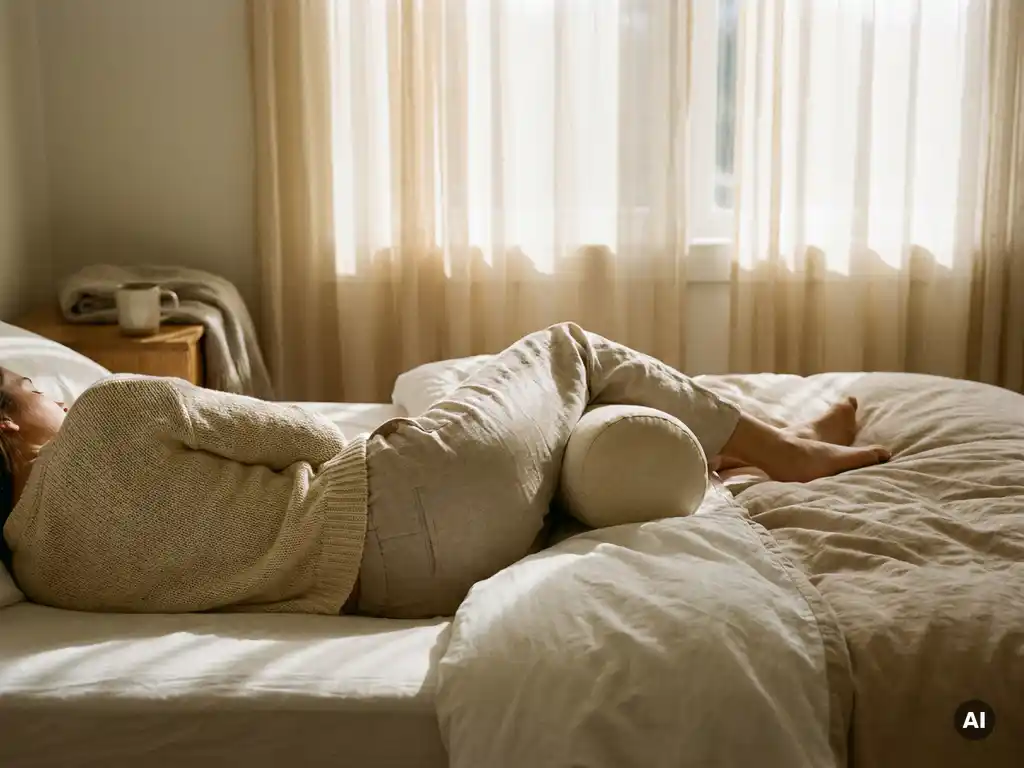
The best sleeping position for back pain is on your back with a pillow under your knees, or on your side with a pillow between your knees. Both positions support the natural curvature of the spine and reduce unnecessary tension on vertebrae, intervertebral discs, and surrounding muscles. Sleeping on your stomach is the least favorable position for people with back complaints.
If you sleep on your back, a pillow under your knees ensures that your lumbar vertebrae remain slightly bent. This significantly reduces tension in the lower back. If you suffer from neck or upper back pain, a well-supporting pillow helps keep the cervical spine straight.
If you prefer to sleep on your side, opt for the fetal position with your knees slightly drawn up. Place a firm pillow between your knees to prevent your upper leg from tilting forward, twisting your pelvis and lower back. Switch sides regularly to prevent overloading one side.
Sleeping on your stomach forces your head and neck into a twisted position and increases the curve in the lumbar vertebrae. This leads to extra tension and pain in many people, especially with existing back complaints. Try to avoid this position as much as possible.
What type of mattress and pillow help with back pain?
A medium-firm mattress provides the best support for most people with back pain. The mattress should conform to your body without sinking too much, so the spine remains in a neutral alignment. The right pillow depends on your sleeping position and the shape of your neck and shoulders.
A mattress that is too soft lets your hips and shoulders sink too deeply, causing the spine to sag. A mattress that is too firm provides insufficient pressure relief at pressure points, creating tension points in the shoulders and hips. A medium-firm to firm mattress offers the best balance for most back complaints.
A similar logic applies to pillows. Back and stomach sleepers benefit from a lower, less thick pillow that does not push the neck too far up. Side sleepers, on the other hand, need a higher, firmer pillow that fills the space between the head and shoulder. Memory foam and latex are popular materials because they conform to the shape of the head and neck.
Do not replace your mattress or pillow too quickly if purchasing alone is not sufficient. The cause of back pain is often deeper than just the sleep surface.
Why does back pain often get worse at night?
Back pain gets worse at night because your body remains in the same position for a long time during sleep, causing muscles to stiffen and circulation to decrease in certain areas. In addition, your pain threshold drops during the night and there is no movement to keep joints and intervertebral discs supple.
During the day, movement provides a constant flow of fluid in and out of the intervertebral discs, keeping them supple and shock-absorbing. While lying down, this dynamic loading largely stops. Depending on your sleeping position, more pressure may actually build up on certain vertebrae, intensifying pain.
Stress and mental tension also play a role. Those who go to bed tense unconsciously hold more muscle tension, including in the back and shoulders. This chronic muscle tension can worsen at night and contribute to a restless night and a more painful morning.
In some people, nighttime back pain points to an underlying cause such as a herniated disc, an inflammatory response, or problems with the spine itself. If the pain structurally worsens at night and is not related to your posture or movement, it is wise to have this investigated.
How can I wake up less stiff in the morning?
To wake up less stiff in the morning, it helps to do a few simple movements in bed before getting up, to optimize your sleeping position, and to relax your muscles before going to sleep. A consistent sleep routine with sufficient hours of sleep also supports the recovery of muscles and joints.
Try this approach for a smoother morning:
- Move before getting up: Slowly pull your knees to your chest, gently roll from side to side, and stretch your body calmly before swinging your legs over the side of the bed.
- Get up slowly: Roll onto your side, place your hands beside you, and rise through a seated position. Avoid abrupt movements from a lying position.
- Do a short stretching routine: A few minutes of light stretching exercises for the hips, hamstrings, and lower back help get the circulation going and reduce stiffness.
- Take a warm bath or shower: Heat relaxes muscle tension and promotes circulation, which can significantly reduce morning stiffness.
- Check your sleeping position: Use the right pillows as described above to limit overloading of muscles and joints during the night.
Sleep deprivation also worsens morning stiffness. Muscles and tissues recover mainly during the deep sleep phases. Those who structurally sleep too little give the body insufficient time to recover from daily strain.
When is back pain during sleep a reason to seek help?
Back pain during sleep is a reason to seek help if the pain persists for more than a few weeks, is accompanied by radiating pain to the legs or arms, or if you are structurally unable to sleep due to the pain. Professional examination is also advisable with a sudden worsening without a clear cause.
Warning signs where you should not wait include:
- Pain that radiates to the legs, feet, or arms, which may indicate nerve compression or a herniated disc
- Numbness, tingling, or loss of strength in the limbs
- Back pain after a fall, accident, or other trauma
- Pain that is worse at night than during the day and does not respond to changes in posture
- Persistent morning stiffness lasting more than an hour, which may indicate an inflammatory condition
Many people wait too long to seek help and try to manage complaints themselves with painkillers or rest. This does not resolve the underlying cause and can lead to chronic complaints that are more difficult to treat. An early, targeted approach yields the best results in the long term.
How Ruggensteun helps with back pain and sleep
We understand that back pain disrupting your night’s sleep has an enormous impact on your daily life. At Ruggensteun, we look beyond the pain itself: we investigate the underlying cause in the spine and nervous system and treat it in a targeted manner. This way, you address the problem structurally rather than merely suppressing the symptoms.
This is what we offer:
- Specialized chiropractic treatments focused on the spine, including certified Y-strap treatments for spinal decompression
- Personal examination in which we map out the cause of your back complaints and sleep problems
- Treatments for all ages, from acute complaints to preventive care
- Quick availability for urgent complaints, without a referral from a general practitioner
- Locations in Eindhoven and Valkenswaard with free parking at both locations
Are you sleeping poorly due to back pain and want to know what is going on? make an appointment and come in for a personal examination. Do you have a question first? contact us and we will help you further.
Sorry, the comment form is closed at this time.