


Jul
What does a Y-strap treatment feel like?
A y-strap treatment feels surprisingly pleasant for most people: you experience a gentle yet powerful traction force along the entire spine, followed by a deep sense of relaxation. Many people describe the sensation as relief — as if space is being created that had long been missing. In this article, we answer the most frequently asked questions about what a y-strap treatment feels like, what it does to your body, and who it is suitable for.
Is a y-strap treatment painful?
For most people, a y-strap treatment is not painful. The traction force applied along the spine actually feels like relief to many — not discomfort. That said, mild muscle tension or fatigue may occur during or immediately after the treatment, similar to the feeling after an intensive stretching session.
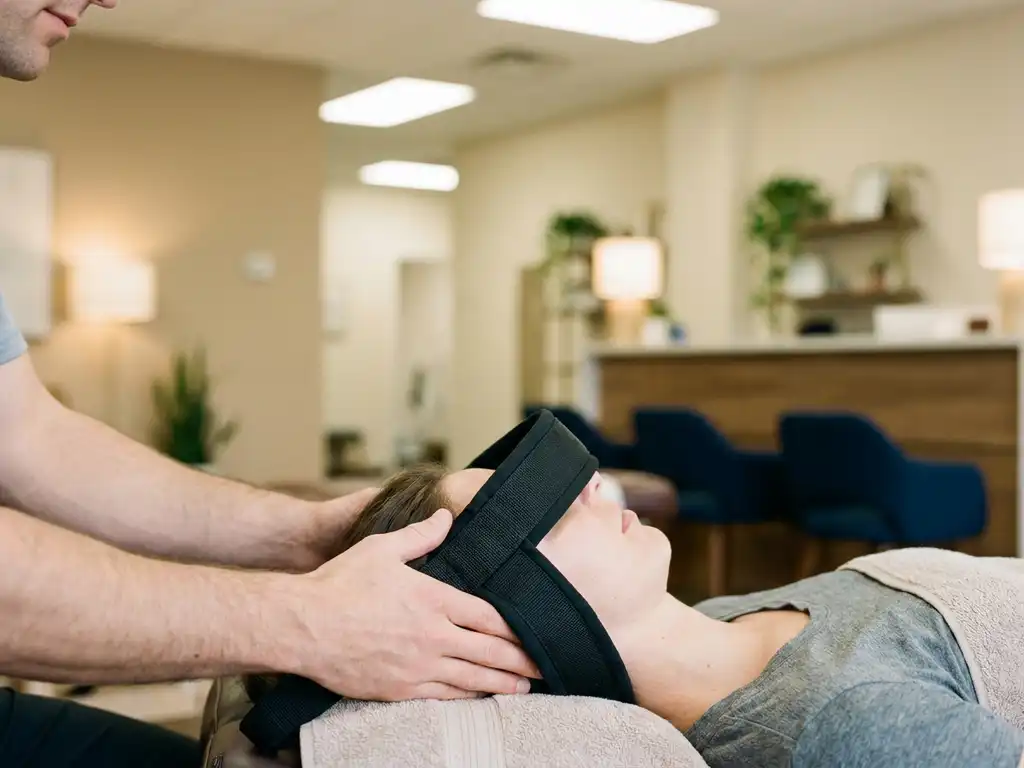
The treatment works through decompression: the y-strap is placed around the back of the head and neck, after which the chiropractor applies a controlled traction force. This movement creates space between the intervertebral discs. That may sound intense, but in practice most people experience it as a liberating sensation.
It is normal for your body to need a little time to adjust, especially if your spine has been tense or restricted for an extended period. Mild muscle soreness in the first day or two after the treatment is not uncommon. This is a sign that your body is adapting to its new position and improved mobility. If you have concerns about pain or are sensitive in the neck area, always discuss this with your chiropractor beforehand.
What happens to your spine during a y-strap treatment?
During a y-strap treatment, the spine is stretched along its length, causing decompression of the intervertebral discs. This means that the pressure on the discs is temporarily reduced, giving them more space and allowing them to function better. At the same time, the surrounding muscles, tendons, and joints are gently stretched.
The chiropractor chooses between two techniques depending on your complaint and the condition of your spine:
- Slow stretch movement: A slow, fluid, and controlled movement aimed at general decompression and relaxation. No abrupt impulses — just a gradual release of tension.
- HVLA movement (High Velocity Low Amplitude): A rapid movement with limited displacement, used when an actual chiropractic adjustment is needed — for example, in the case of a restricted vertebra or functional limitation. HVLA is a recognized technique within manual medicine and is applied worldwide.
During the treatment, you may sometimes hear a cracking or popping sound. This is caused by gas bubbles being released from the joint fluid as the joint space opens. The sound is more impressive than it is significant and is completely normal during chiropractic treatments.
How do you feel immediately after a y-strap treatment?
Immediately after a y-strap treatment, most people experience a combination of lightness, relaxation, and an improved sense of freedom of movement. Many describe it as “standing taller” or “moving more easily.” The neck feels more supple, and headaches or shoulder tension may be noticeably reduced right away.
That said, every body responds differently. Some people feel mildly fatigued after their first treatment or experience slight muscle soreness in the neck or back. This is a normal reaction and typically resolves on its own within a day or two. The body needs time to adjust to its new position and improved nerve communication.
Others experience immediate and significant relief from complaints they have carried with them for a long time. This is also why y-strap traction therapy is regarded by many as a particularly powerful treatment. The effect varies from person to person and from complaint to complaint, but the immediate sensation is almost always positive.
How long do the effects of a y-strap treatment last?
The effects of a y-strap treatment vary from person to person and depend heavily on the nature and duration of the complaint. For acute complaints, a single treatment can already provide noticeable and long-lasting relief. For chronic neck complaints or recurring back pain, multiple treatments are often needed to achieve structural improvement.
A single session provides decompression and immediate relief, but for long-standing complaints the spine needs time to stabilize in its improved position. Muscles, ligaments, and the nervous system must adapt to the new alignment. This is why a treatment plan with multiple sessions is generally more effective than a one-time intervention.
Preventive treatments and maintenance also play a role. People who visit a chiropractor regularly notice that the effects last longer and that complaints return less quickly. This fits an approach that not only addresses symptoms but also structurally tackles the underlying cause of the complaint.
Who is a y-strap treatment suitable for?
A y-strap treatment is suitable for people with neck pain, back pain, headaches, shoulder tension, or complaints related to pressure on the intervertebral discs. It is a non-invasive back treatment without surgery or medication, making it an attractive option for those seeking a natural approach to their complaints.
The treatment has broad applications, but is not suitable for everyone. There are situations where extra caution or an alternative approach is more appropriate, such as:
- Severe osteoporosis or bone loss
- Recent vertebral fractures or spinal surgery
- Certain forms of rheumatism or joint inflammation
- Severe herniation with neurological deficits
A good chiropractor will always assess your situation first before beginning a y-strap treatment. An intake consultation and any additional examination are part of a responsible approach. If you are unsure whether the treatment is right for you, discuss this beforehand.
What sets the y-strap apart from other chiropractic techniques?
The y-strap distinguishes itself from other chiropractic techniques by decompressing the entire spine in a single movement — from the lower back all the way up to the neck. Most other techniques target a specific joint or spinal segment. The y-strap works more holistically, simultaneously creating space along the full length of the spine.
Other commonly used chiropractic techniques, such as diversified adjustments or drop-table techniques, are aimed at correcting individual vertebrae. They are effective for specific restrictions but do not offer the same broad decompression as y-strap traction therapy. The y-strap is therefore often used as a complement to a broader treatment plan, rather than as a replacement for other techniques.
Another distinguishing feature is the direct, tangible sensation. The traction force is physically perceptible and the effect is immediately noticeable for many people. This makes the y-strap a more powerful experience for some than subtler adjustment techniques. At the same time, it requires a high level of skill and specialized training — not every chiropractor in the Netherlands is certified to perform this technique safely.
How we at Ruggensteun help with y-strap treatments
We are one of the few chiropractic practices in the Netherlands certified to perform y-strap treatments. We take that distinction seriously: the technique requires specialized training and expertise to be safe and effective. At our practice, a thorough intake always comes first, so we can determine which approach best suits your complaint.
What we offer:
- Certified y-strap treatments performed by specialized chiropractors
- A choice between slow stretch movements or HVLA techniques, tailored to your situation
- Treatments for neck pain, back pain, headaches, and chronic complaints
- Quick appointment availability, including for acute complaints
- Locations in Eindhoven and Valkenswaard with free parking
- No referral from a general practitioner required
Would you like to know whether a y-strap treatment is right for you? Contact us directly or schedule an appointment at our practice in Eindhoven or Valkenswaard. We are happy to think along with you.
Sorry, the comment form is closed at this time.