


Jun
How do you know if neck pain has a structural cause?
You can recognize that neck pain has a structural cause when symptoms persist for more than two to three weeks, return after temporary relief, or are accompanied by radiating pain, tingling, or restricted movement. Muscle tension typically resolves on its own with rest; structural neck pain does not. In this article, we answer the most frequently asked questions about structural neck complaints, from early warning signs to effective treatment options.
What are the signs that neck pain is more than muscle tension?
Neck pain that goes beyond ordinary muscle tension is characterized by persistent or recurring symptoms that do not go away with rest, heat, or over-the-counter pain relievers. Other warning signs include radiating pain into the shoulder or arm, tingling or numbness in the fingers, chronic tension headaches, and stiffness when turning the head.
Muscle tension usually has a specific trigger, such as sleeping in an awkward position or going through a stressful period. The pain tends to be diffuse and disappears within a few days. Structural neck pain behaves differently: the symptoms are more stubborn, have a distinct location, and keep coming back — even after the immediate trigger has been removed.
Watch out for the following signs as well:
- Pain that radiates to the back of the head or the temples
- Numbness or tingling in the arm, hand, or fingers
- Restricted range of motion when turning or tilting the head
- Symptoms that worsen with prolonged sitting, screen work, or stress
- Recurring headaches that start in the neck
The more of these signs you recognize, the greater the likelihood that a structural cause is involved — one that deserves proper attention.
What are common structural causes of neck pain?
Common structural causes of neck pain include a blocked or misaligned vertebra, overloaded intervertebral discs, joint degeneration in the cervical spine, and chronic nerve compression resulting from prolonged poor posture. These causes are not visible from the outside, but they do significantly affect how the body functions.
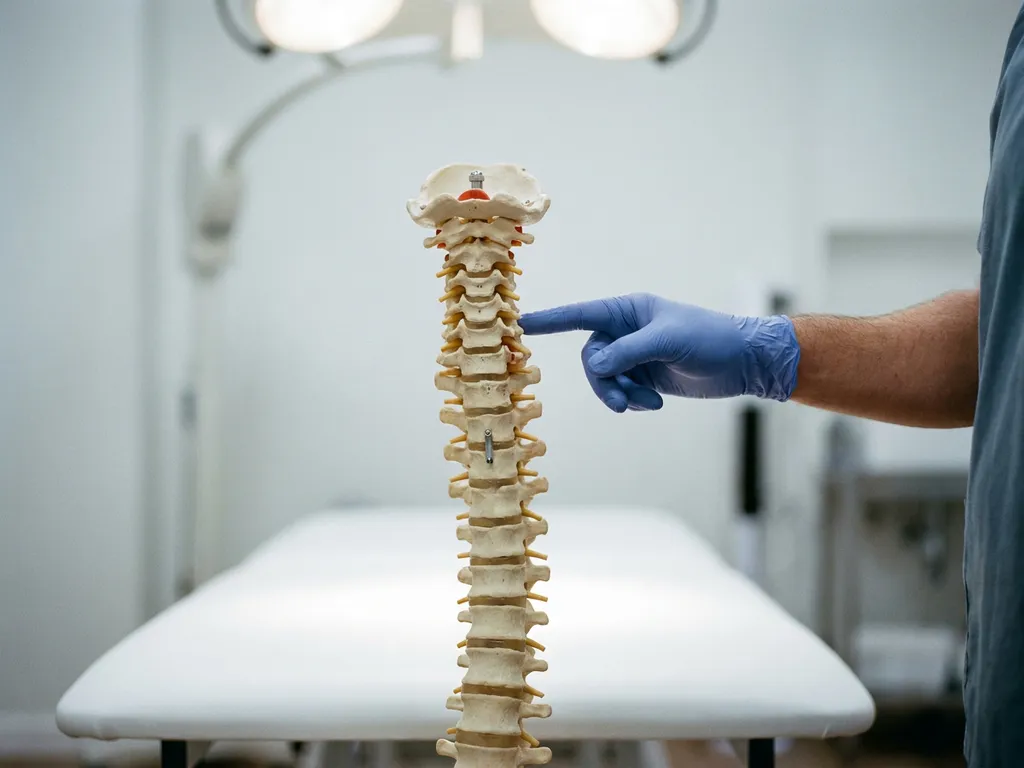
The cervical spine consists of seven vertebrae that together form the neck. Between each vertebra sits an intervertebral disc that absorbs pressure and allows for movement. When these discs become overloaded — through a combination of poor posture, sleep deprivation, stress, or excessive strain — the pressure within the discs can increase. This leads to irritation of the surrounding nerves and muscles.
Other structural causes include:
- Subluxation or joint blockage: a vertebra that no longer moves freely within its joint
- Cervical osteoarthritis: degeneration of the small joints in the neck, more common in people over forty
- Cervical disc herniation: a bulging intervertebral disc pressing on a nerve
- Chronic muscle hardening: muscles that can no longer fully relax due to prolonged overuse
It is important to understand that structural causes rarely develop from a single incident. They are the result of accumulated strain over time, during which the body becomes progressively less able to compensate.
How does structural neck pain differ from ordinary muscle pain?
The most important difference between structural neck pain and ordinary muscle pain is the recovery pattern. Muscle pain typically disappears within three to seven days and responds well to rest, movement, and heat. Structural neck pain lasts longer, responds less readily to simple measures, and tends to return regularly without any clear new trigger.
Ordinary muscle pain feels diffuse and can easily be pinpointed with a finger. The muscle is tender to the touch, and the pain decreases as the muscle relaxes. Structural neck pain has a deeper, sometimes sharper quality. The pain can radiate and is sometimes harder to describe or pinpoint.
Another distinguishing feature is the response to movement. With muscle pain, moving around quickly feels better after the initial stiffness. With structural neck complaints, certain movements can actually make the pain worse, or there may be specific directions in which the head cannot turn further without causing pain.
Finally, the pattern over time matters. Have you experienced neck pain in the same area multiple times, even without a clear trigger? If so, there is a good chance that an underlying structural cause is at play — one that has not yet been addressed.
When should you see a chiropractor for neck pain?
You can see a chiropractor for neck pain as soon as symptoms have persisted for more than two weeks, recur regularly, are accompanied by radiating pain or restricted movement, or when you feel that the cause runs deeper than ordinary muscle tension. No referral from a general practitioner is required.
Many people wait too long to seek help, hoping the symptoms will resolve on their own. With structural neck complaints, that wait is rarely worthwhile. The longer a joint or intervertebral disc is under abnormal pressure, the more the body compensates — and those compensations in turn lead to new complaints in the shoulders, back, or head.
A chiropractor is specifically trained to assess and treat complaints of the spine and nervous system. There is no need to visit a general practitioner or physical therapist first. Direct accessibility is a real advantage, especially when you want to quickly determine whether a structural cause is involved.
How does a chiropractor diagnose a structural neck complaint?
A chiropractor diagnoses a structural neck complaint through a combination of a detailed patient history, orthopedic and neurological tests, and a manual examination of the spine. This process assesses which vertebrae have restricted movement, where nerves are under pressure, and what the overall alignment of the cervical spine looks like.
During the initial consultation, questions are asked about the progression of symptoms, previous treatments, posture, work activities, and lifestyle. This is followed by a physical examination in which the chiropractor tests the mobility of the neck, assesses muscle tension, and evaluates specific pressure points.
Orthopedic tests help determine whether nerves are involved, while neurological tests map out radiating pain, reflexes, and muscle strength. Based on all of this information, a treatment plan is developed that targets the actual cause of the symptoms — not just the location where the pain is felt.
Which treatments are effective for structural neck pain?
For structural neck pain, treatments that focus on restoring spinal alignment, relieving pressure on intervertebral discs, and improving nerve communication are the most effective. Chiropractic adjustments, spinal decompression, and techniques such as the Y-strap are among the most widely used non-invasive treatment options.
Chiropractic manipulation aims to free blocked joints in the cervical spine. When a vertebra no longer moves freely, this affects the surrounding muscles, nerves, and discs. By restoring mobility, pressure on the nervous system is reduced and the body is better able to heal.
The Y-strap treatment is a specialized technique in which the head is drawn along the vertical axis of the body. This creates targeted decompression in the intervertebral discs of the neck. The technique can be performed as a slow stretching movement for general relaxation and pressure relief, or as an HVLA movement (High Velocity Low Amplitude) when a specific chiropractic adjustment is needed. Y-strap traction therapy is not available at every chiropractic practice: it requires specific certification and training.
Other treatment options that can support recovery from structural neck complaints include:
- Dry needling: targeting deep muscle knots in the neck and shoulder
- Cranial Facial Release (CFR): for complaints in which tension in the skull and face plays a role
- Posture correction and exercises: as a supplement to treatment to prevent relapse
How Ruggensteun helps with structural neck pain
At our practices in Eindhoven and Valkenswaard, we treat structural neck complaints with a personal and thorough approach. We always look for the true cause of the symptoms, not just temporary pain relief. Our chiropractors are specialized in a wide range of techniques, including the Y-strap treatment for neck pain — a technique we are certified to perform, as one of the few certified practices in the Netherlands.
What we offer:
- A comprehensive initial examination to identify the structural cause of your neck complaints
- Certified Y-strap spinal decompression for targeted pressure relief in the cervical spine
- Specialized treatments such as dry needling and CFR as supplementary options where needed
- Treatments for all ages, without a referral from a general practitioner
- Quick appointment availability, including for acute complaints
- Free parking at both locations
Have you been dealing with neck pain that keeps coming back, or would you like to find out whether there is a structural cause behind your symptoms? Contact us directly or schedule an appointment through our website. We are happy to help you on your way to lasting recovery.
Sorry, the comment form is closed at this time.