


Sep
Can Sitting Too Much Cause Back Pain?
Yes, sitting for long periods can certainly cause back pain. Prolonged sitting increases pressure on the intervertebral discs, weakens the muscles that support the spine, and leads to a posture that structurally strains the back. This applies to virtually everyone who regularly spends hours at a desk, behind the wheel, or in front of a screen. In this article, we answer the most frequently asked questions about back pain from sitting and what you can do about it.
Which muscles and structures become overloaded from prolonged sitting?
During prolonged sitting, the hip flexors, lower back muscles, and gluteal muscles in particular become overloaded or weakened. At the same time, pressure on the intervertebral discs in the lumbar spine increases significantly. The structures that suffer most are the lumbar vertebrae, the intervertebral discs, the sacroiliac joints, and the muscles around the pelvis.
When you sit, the hip flexors are constantly in a shortened position. Over time, they become shortened and tense, which affects pelvic tilt and places extra strain on the lower back. At the same time, the gluteal muscles are barely activated and lose strength. This disrupts the balance between the front and back of the pelvis.
The intervertebral discs bear more pressure when seated than when standing or lying down. In a forward-bent posture, that pressure increases even further. Over time, this can lead to dehydration of the discs and a greater risk of complaints such as a herniated disc or degenerative changes in the spine.
How does back pain develop from poor sitting posture?
Back pain from poor sitting posture develops because the spine is held outside its neutral position for extended periods. A forward-bent back, a sunken pelvis, or an uneven shoulder position causes uneven loading of vertebrae, muscles, and ligaments. The body compensates for this, resulting in muscle tension and pain.
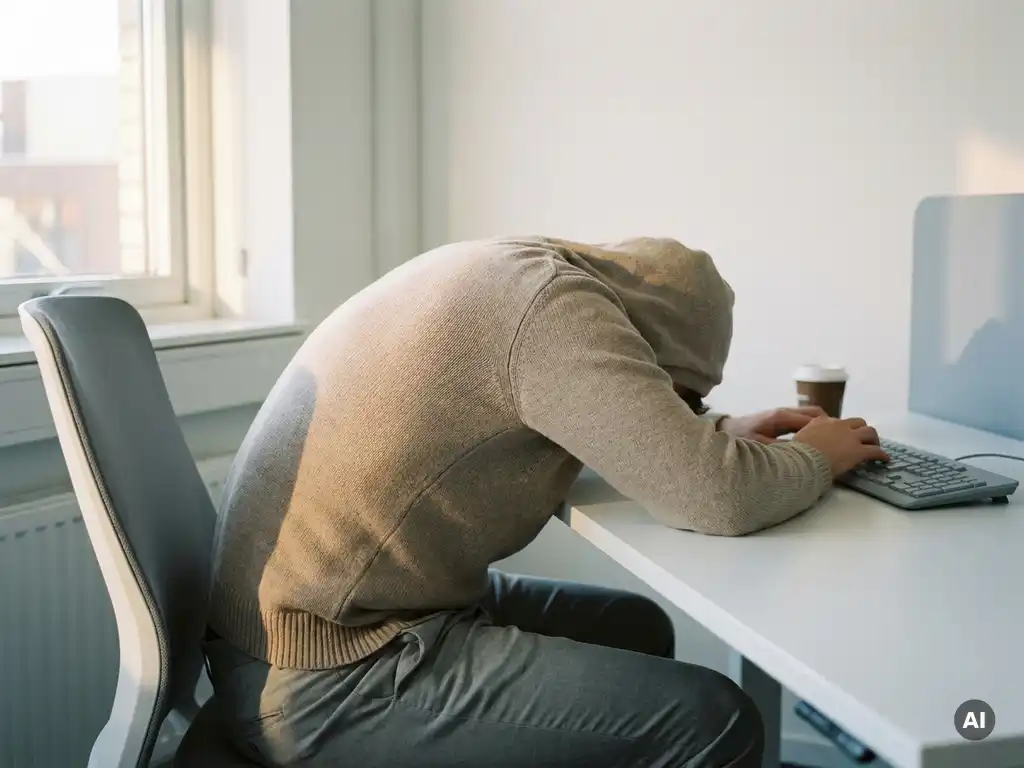
A common posture is the so-called C-curve: the lower back is sunken, the shoulders hang forward, and the head protrudes above the screen. In this position, the neck muscles work overtime to support the head and the lumbar spine is under constant pressure.
Posture and work are closely linked. People with office jobs, drivers, or remote workers without an ergonomic workstation are at increased risk of posture-related back complaints. The problem is not only the posture itself, but also the duration. Even a reasonably good sitting posture becomes harmful if you do not vary it for hours on end.
What is the difference between acute and chronic back pain from sitting?
Acute back pain from sitting comes on suddenly, lasts less than six weeks, and often has a clear trigger, such as a long car journey or a day at a poorly adjusted desk. Chronic back pain lasts longer than three months and is the result of persistent overloading, structural posture problems, or untreated underlying causes.
Acute back pain from sitting
Acute pain often feels sharp or stabbing and usually disappears after rest, movement, or adjustment of posture. The body sends a clear signal that something is wrong, but the damage is generally limited. Timely adjustment of habits prevents the complaint from becoming chronic.
Chronic back pain from sitting
Chronic back pain is more insidious. The complaints creep in, are less intense but persistent, and respond less well to simple measures. Multiple factors often play a role simultaneously: weakened muscles, altered joint mobility, tension in the nervous system, and sometimes also stress. A structural approach is then necessary.
When is back pain from sitting a sign of a more serious problem?
Back pain from sitting is a sign of a more serious problem when the pain radiates into the legs, is accompanied by tingling or numbness, does not improve with rest, or occurs alongside other complaints such as loss of strength in the legs, problems with the bladder or bowels, or unexplained weight loss. In those cases, professional examination is necessary.
Radiating pain towards the buttocks or legs can indicate a pinched nerve, a herniated disc, or other pressure on the spine. These are complaints where you should not wait too long before seeking help. The longer a nerve is under pressure, the longer recovery can take.
If back pain keeps returning after short periods of relief, that is also a sign that the cause has not yet been addressed. Recurring complaints are rarely coincidental and deserve a thorough evaluation of the spine and nervous system.
How does chiropractic care help with back pain from prolonged sitting?
Chiropractic care helps with back pain from prolonged sitting by restoring the mobility of the vertebrae, reducing pressure on intervertebral discs and nerves, and improving communication between the nervous system and the rest of the body. This addresses not only the pain, but also the underlying cause of the complaints.
With posture-related back complaints, vertebrae are often slightly shifted or blocked as a result of prolonged pressure and muscle imbalance. A chiropractor returns these vertebrae to a better position through targeted adjustments. This reduces pressure on surrounding structures and gives the body the space to heal itself.
For people with severe compression in the spine, for example from prolonged sitting combined with wear or a herniated disc, spinal decompression can be an effective approach. Techniques such as spinal traction specifically target the relief of pressure in the intervertebral discs and the restoration of space between the vertebrae.
What can you do yourself to reduce back pain from sitting?
To reduce back pain from sitting, the most effective approach is a combination of regular movement, ergonomic adjustments, and targeted exercises for the core and hip flexors. Small changes in daily habits already make a big difference to the load on the spine.
- Stand up every 30 to 45 minutes and walk for a few minutes, even if it is only briefly. Movement stimulates blood flow to the intervertebral discs.
- Set up your workstation ergonomically: a chair at the right height, a screen at eye level, and both feet flat on the floor.
- Stretch the hip flexors daily with a simple lunge or kneeling stretch to counteract the shortening caused by sitting.
- Strengthen the core muscles through exercises such as planks, bridges, or Pilates. A strong core supports the spine during prolonged sitting.
- Pay attention to your breathing: shallow chest breathing increases muscle tension in the neck and shoulders. Abdominal breathing relaxes the body and reduces the load on the spine.
- Vary your sitting position instead of staying in one position all day. A sit-stand desk can help with this.
Consistency is more important than perfection here. Those who take small steps daily often notice improvement in complaints and posture within just a few weeks.
How Ruggensteun helps with back pain from prolonged sitting
At Ruggensteun, we understand that back pain from sitting is rarely a simple problem. It involves a combination of postural patterns, muscle imbalance, joint mobility, and the functioning of the nervous system. Our approach is focused on the cause, not just the pain.
- Thorough analysis of the spine and posture to understand exactly where the pressure lies
- Chiropractic adjustments to mobilize blocked vertebrae and reduce pressure on nerves and intervertebral discs
- Spinal decompression via techniques such as the Y-Strap for people with more severe compression complaints
- Personal advice on posture, workstation, and movement, tailored to your situation
- No referral needed from a general practitioner and free parking at both locations in Eindhoven and Valkenswaard
Do you suffer from back pain due to prolonged sitting and would you like to know what we can do for you? Make an appointment or contact our team. We are happy to help you.
Sorry, the comment form is closed at this time.