


Jul
Can a y-strap help with neck pain caused by screen work?
Yes, a y-strap treatment can help with neck pain caused by prolonged screen use. The technique focuses on decompressing the intervertebral discs in the cervical spine, relieving tension that builds up from sitting hunched forward for extended periods. In this article, we answer the most frequently asked questions about the y-strap and neck complaints caused by screen work.
What does prolonged screen use do to your neck and spine?
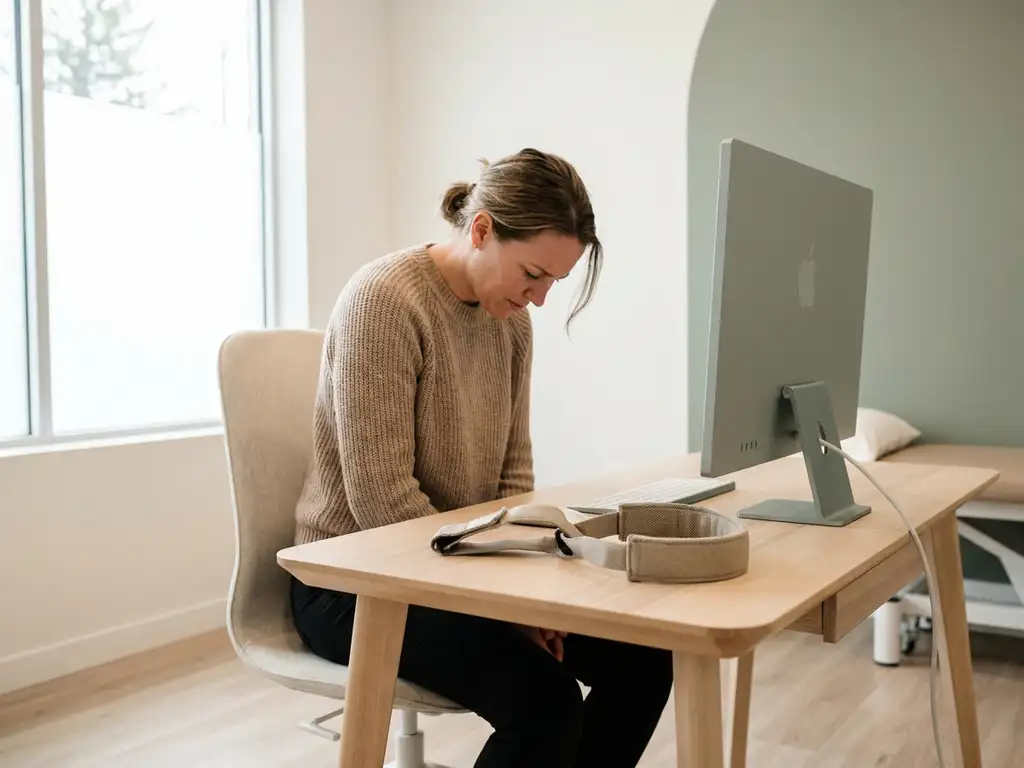
Prolonged screen use places structural stress on the cervical spine in ways most people underestimate. When you sit in front of a screen for hours with your head slightly forward, the pressure on the cervical vertebrae and intervertebral discs increases significantly. This leads to chronic neck complaints whose root cause goes deeper than simple muscle tension.
The head weighs an average of five to six kilograms in a neutral position. As soon as you tilt your head a few centimeters forward, the effective load on the cervical vertebrae increases sharply. Do this daily for several hours, and the muscles, joints, and intervertebral discs become overloaded. The consequences will be familiar to many office workers:
- Stiffness and pain in the neck and shoulders
- Headaches that radiate upward from the neck
- Tingling or radiating pain into the arms or hands
- Reduced range of motion in the neck
- Fatigue and difficulty concentrating due to nerve irritation
The problem with screen-related neck pain is that symptoms develop gradually. People accept the pain as normal until the complaints become chronic. Treating symptoms with painkillers or temporary massage does not address the underlying cause: the structural strain on the spine and the disrupted nerve communication that comes with it.
How does the y-strap technique work for neck complaints?
The y-strap technique works through targeted traction along the spine, in which a special harness is placed around the head and a controlled pulling force is applied. This creates decompression in the intervertebral discs, opening up space between the vertebrae and reducing pressure on the nerves. For neck complaints caused by screen work, the treatment focuses specifically on the cervical spine.
Based on the complaint and the condition of the spine, the chiropractor chooses between two methods:
Slow stretch movement
In the standard approach, the chiropractor performs slow, fluid, and controlled stretching movements. This method is aimed at general decompression and relaxation of the cervical vertebrae, without abrupt impulses. It is often the first choice for people undergoing a y-strap treatment for the first time, or for those whose neck complaints are primarily the result of prolonged overuse.
HVLA movement
When a blocked vertebra or functional restriction is present, the chiropractor opts for a High Velocity Low Amplitude movement. This is a rapid movement with minimal displacement that delivers an actual chiropractic adjustment. HVLA is a recognized technique within manual medicine and is used worldwide. After such an adjustment, many people immediately experience greater freedom of movement in the neck.
Both techniques work on the same principle: by reducing pressure on the intervertebral discs, nerves can function more freely and pain signals diminish. This aligns with the holistic view that the nervous system plays a central role in the body’s recovery process.
What are the advantages of the y-strap compared to other neck treatments?
The y-strap treatment sets itself apart from other neck treatments by directly addressing the structural cause of the complaint: the increased pressure on the intervertebral discs. While massage temporarily relieves muscle tension and painkillers suppress symptoms, y-strap traction therapy focuses on restoring space between the vertebrae and improving nerve function.
Concrete advantages over common alternatives:
- Non-invasive: No surgery or injections are used, which greatly reduces the risk of side effects
- Direct decompression: The traction force acts immediately on the intervertebral discs, providing instant relief for many people
- Root-cause focused: Rather than masking symptoms, the mechanical strain causing the complaints is directly addressed
- Compatible with other treatments: The y-strap can be combined with other chiropractic techniques as part of a comprehensive treatment plan
- Suitable for recurring complaints: People who repeatedly experience neck pain after screen work benefit from this structural approach
For people who have previously been disappointed by treatments that offered only temporary relief, y-strap spinal decompression offers a different approach: one focused on restoring balance in the musculoskeletal system rather than masking pain.
Who is a y-strap treatment suitable for when dealing with neck pain?
A y-strap treatment is suitable for people with neck pain resulting from prolonged overuse, such as screen work, as well as for recurring neck complaints, headaches originating from the neck, or stiffness after extended periods of sitting. The treatment is not suitable for everyone, and a thorough intake with a certified chiropractor is always the first step.
The treatment is generally suitable for:
- Office workers and remote workers with chronic neck complaints
- People with headaches or migraines triggered by the cervical vertebrae
- Individuals with radiating complaints to the shoulders or arms due to nerve irritation
- Athletes with neck injuries or overuse complaints
- People who have previously received treatment but whose complaints keep returning
There are also situations in which the y-strap is not immediately used, such as with certain spinal conditions, osteoporosis, or recent injury. A qualified chiropractor always first assesses whether the technique is appropriate for your specific situation. That is what makes the intake so important: not everyone with neck pain has the same underlying cause or requires the same treatment plan.
How many y-strap sessions are needed for neck pain caused by screen work?
The number of y-strap sessions needed for neck pain caused by screen work varies from person to person and depends on the severity of the complaints, how long they have been present, and the overall condition of the spine. Many people experience relief after the very first session, but multiple treatments are generally needed for a lasting result.
For neck complaints that have developed recently and have not yet become chronic, a short course of a few sessions can already make a significant difference. For long-standing or recurring complaints that have built up over months or years of screen work, a longer approach is more realistic. A chiropractor will draw up a treatment plan after the intake that fits your individual situation.
In addition to the treatments themselves, lifestyle factors also play a role. Anyone who sits in front of a screen for hours every day would do well to pay attention to posture, movement breaks, and ergonomics. A y-strap treatment resolves the structural tension that has built up, but without adjustments to daily habits, complaints can return. Preventive maintenance sessions can then help keep the spine in balance.
Where can you find a certified y-strap chiropractor in the Netherlands?
Certified y-strap chiropractors are scarce in the Netherlands. Not every chiropractor is authorized to perform this technique, as the treatment requires specific training and certification. It is important to consciously choose a qualified and trained professional, because the safety of the treatment depends directly on the expertise of the practitioner.
When searching for a y-strap chiropractor in the Netherlands, these are the most important criteria:
- Demonstrable certification for the y-strap technique
- Experience with both the slow stretch movement and the HVLA variant
- A thorough intake prior to the first treatment
- Clear explanation of the treatment and what to expect
- Direct accessibility without a referral from a general practitioner
How we help with neck pain caused by screen work
At Ruggensteun, we are one of the few chiropractic practices in the Netherlands with an official certification for the y-strap treatment. Our chiropractors in Eindhoven and Valkenswaard have extensive experience with neck complaints caused by screen work and create a personalized treatment plan for every patient. We offer:
- A comprehensive intake in which we identify the cause of your neck complaints
- Y-strap treatments performed by certified and trained chiropractors
- Combination of y-strap with other techniques such as HVLA, CFR, or dry needling where needed
- Advice on posture, ergonomics, and prevention to avoid recurring complaints
- Quick appointment availability, including for acute complaints
- Free parking at both locations and no referral from a general practitioner required
Are you experiencing neck pain from screen work and want to know whether a y-strap treatment is right for you? Contact us directly or schedule an appointment in Eindhoven or Valkenswaard. We are happy to help.
Sorry, the comment form is closed at this time.