


Oct
What Is the Best Way to Sit With Back Pain?
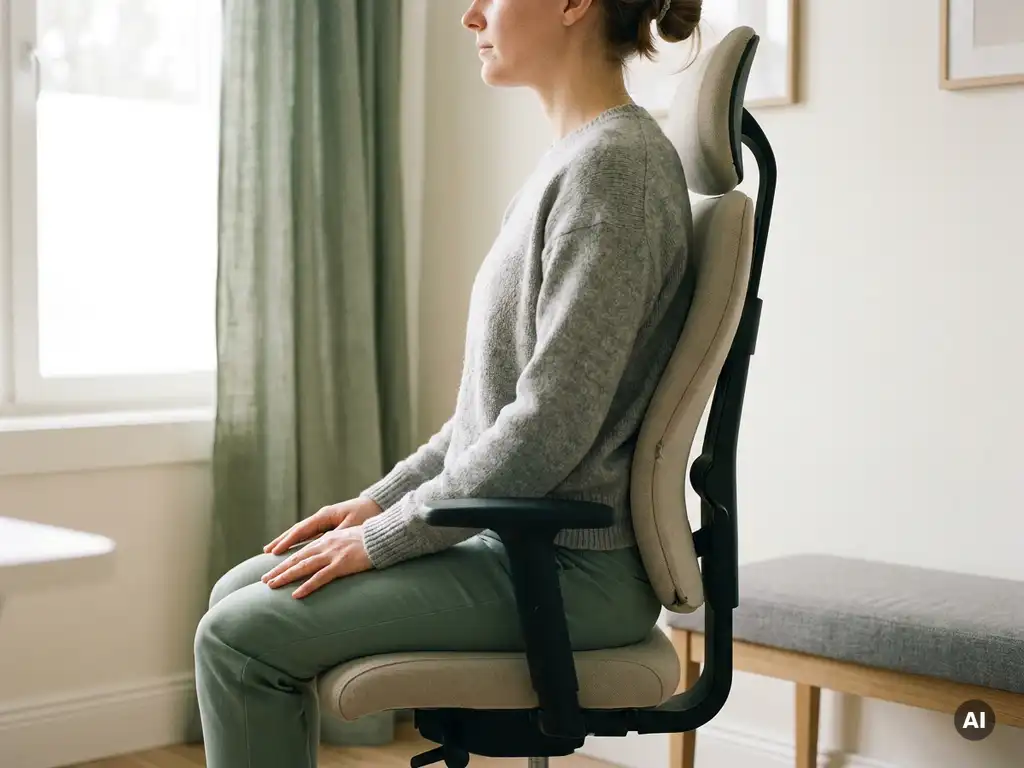
The best sitting posture for back pain is a straight, supported position where your lower back maintains a slight natural curve and your feet are flat on the floor. Make sure your knees are approximately at hip height and your shoulders remain relaxed. How you sit largely determines how much pressure your spine has to endure, and small adjustments can already make a big difference. In this article, we answer the most frequently asked questions about sitting and back pain, from the correct posture to when you need professional help.
Which sitting posture reduces pressure on your back the most?
A neutral spine posture, in which the natural S-curve of your spine is maintained, reduces pressure on your intervertebral discs the most. Sit upright with your lower back lightly supported, your feet flat on the floor, and your knees at an angle of approximately 90 degrees. Tilt your pelvis slightly forward so your lower back does not collapse.
Many people think that sitting perfectly upright is the solution, but an overly stiff, straight posture can actually build tension in the muscles surrounding the spine. It is about a relaxed neutral position, not a military posture. A lumbar support, such as a small cushion or a rolled-up towel in the hollow of your lower back, helps enormously.
The position of your head also matters. When your head leans forward, for example to look at a screen, the load on your cervical spine increases significantly. Make sure your screen is at eye level so your neck stays straight. With sitting and driving, the same principle applies: adjust your car seat so that your back is fully supported and you can reach the steering wheel without leaning forward.
How long can you sit continuously with back pain?
With back pain, it is advisable to sit for a maximum of 30 to 45 minutes at a time. After that, it is important to stand up briefly, take a short walk, or do a few stretching exercises. Prolonged sitting increases pressure on the intervertebral discs and reduces blood flow to the back muscles.
Our bodies are simply not designed to remain in the same position for hours on end. Even a perfect sitting posture becomes taxing over time, because muscles become fatigued and the spine builds up compression. Moving regularly breaks this pattern and activates the small stabilizing muscles surrounding the spine.
A practical tip is to set a timer on your phone or computer as a reminder to move. With prolonged sitting and driving, it is advisable to take a short break every 45 minutes, step out of the car briefly, and stretch your back. On long journeys, this is important both for your comfort and your safety.
Which chair is best for back problems?
The best chair for back problems is an ergonomic chair with adjustable seat height, lumbar support, adjustable armrests, and a slightly reclined backrest. The chair should support your body, not the other way around. A good chair adapts to you, not you to the chair.
When choosing, pay attention to the following features:
- Lumbar support: the backrest should fill the hollow of your lower back without causing pressure
- Seat depth: there should be a hand’s width of space between the edge of the seat and your knee hollow
- Seat height: adjustable so that your feet are flat on the floor
- Armrests: at a height where your shoulders remain relaxed
- Tilt option: a slight backward tilt of the backrest distributes weight better
An expensive chair is not always better. Even a more affordable chair with the right adjustments can work excellently. What really matters is that you adjust the chair properly to your body and that you do not sit in it all day without moving.
What are the worst sitting habits for your back?
The worst sitting habits for your back are sitting hunched forward for long periods, crossing your legs, slouching, and craning your head forward toward a screen. All of these postures disrupt the natural alignment of the spine and increase pressure on vertebrae, discs, and surrounding muscles.
Here are the most harmful habits listed:
- Slouching: the lower back loses its natural curve, which puts disproportionate strain on the intervertebral discs
- Crossing your legs: this tilts the pelvis and causes asymmetric tension in the hips and lower back
- Head leaning forward: also known as “text neck,” this significantly increases the load on the cervical vertebrae
- Not moving for hours: even a good posture becomes harmful if you stay in the same position for too long
- Incorrect car seat adjustment: when sitting and driving, a seat that is too far from the steering wheel or provides too little back support is a common cause of lower back pain
Awareness is the first step. Many people sit in the same poor posture for years without noticing, until the complaints accumulate.
Does chiropractic care help with back pain caused by poor sitting?
Yes, chiropractic care can be effective in treating back pain that has developed from prolonged poor sitting. A chiropractor realigns the spine, restores mobility to blocked joints, and reduces pressure on nerves that are causing complaints. This addresses the root cause rather than merely suppressing the pain.
When you sit in a poor posture for a long time, vertebrae can shift slightly or joints can become blocked. This disrupts communication between the nervous system and the rest of the body, which can lead to pain, stiffness, radiating complaints, or even headaches. Chiropractic treatment focuses on restoring this alignment and improving nerve communication.
In addition to the treatment itself, a chiropractor also provides practical advice on posture, movement, and ergonomics, so that you can actively contribute to your recovery and prevent future complaints.
When is back pain while sitting a signal to seek help?
Seek professional help if your back pain while sitting persists for more than two weeks, worsens, radiates to your legs or arms, is accompanied by tingling or numbness, or if the pain limits your daily functioning. These are signals that there is more going on than ordinary muscle pain.
Acute pain that comes on suddenly and is severe also deserves immediate attention. The same applies to back pain following a fall, accident, or other impact. In such cases, it is wise not to wait but to make an appointment quickly.
Many people wait too long to seek help because they hope the pain will go away on its own. Unfortunately, delay can lead to further damage or to chronic complaints that are harder to treat. Intervening earlier yields faster and better results in most cases.
How Ruggensteun helps with back pain caused by poor sitting
At Ruggensteun, we treat people every day with back complaints that have developed or worsened due to prolonged sitting, poor posture, or a lot of driving. We always look at the underlying cause of the complaint, not just the pain itself. Our approach is focused on restoring the balance in your spine and nervous system, so that your body can make use of its own healing capacity.
What we offer:
- Chiropractic treatment focused on spinal alignment and nerve decompression
- Specialized Y-Strap treatment for spinal decompression, available with one of the few certified chiropractors in the Netherlands
- Personal advice on posture, ergonomics, and movement, tailored to your situation
- Quick availability of appointments, including for acute complaints, without a referral from your GP
- Locations in Eindhoven and Valkenswaard with free parking
Are you suffering from back pain while sitting or driving and would you like to know what we can do for you? make an appointment or contact us and we will help you as quickly as possible. You can also read more about our treatments and specializations on our website.
Sorry, the comment form is closed at this time.