


Sep
Can My Pillow Cause Neck Pain?
Yes, your pillow can definitely cause neck pain. A pillow that doesn’t keep your head in a neutral position creates a misalignment of the spine that persists for hours throughout the night. This leads to muscle tension, joint strain, and waking up with a stiff or painful neck. In this article, we answer the most frequently asked questions about sleeping and neck pain, so you know exactly what you can do.
What pillow characteristics lead to neck pain?
A pillow causes neck pain when it keeps your head too high, too low, or in a twisted position during sleep. The main characteristics that cause problems are the wrong height, a filling that is too hard or too soft, and material that doesn’t hold its shape. Together, these factors disrupt the natural alignment of your neck and spine.
Specifically, these are the properties that most often lead to complaints:
- Pillow too high: pushes your head forward, causing the muscles at the back of the neck to be constantly stretched.
- Pillow too low or too thin: lets your head sink toward the mattress, creating tension on the side of the neck for side sleepers.
- Filling too soft: provides insufficient support, causing your head to sink and the spine to bend.
- Worn-out pillow: a pillow that has lost its shape no longer supports evenly and creates pressure points.
- Wrong width or shape: a pillow that doesn’t match the width of your shoulders causes a crooked neck position for side sleepers.
The key is that your neck must lie in line with your spine during sleep. As soon as a pillow disrupts that neutral position, your muscles work all night to compensate for the tension. After eight hours, that’s enough to wake up stiff the next morning.
How do you know if your neck pain is caused by your pillow?
Your pillow is probably the cause of your neck pain if the symptoms are worst in the morning and decrease as the day goes on. This pattern is a clear signal that the complaint is related to your sleeping position or your pillow, and not to an activity during the day.
Watch for the following signs that point to a pillow-related cause:
- You wake up with a stiff neck that loosens up after a few hours.
- You have a headache in the morning that disappears later in the day.
- Your neck feels better after a night sleeping on a different pillow, in a different bed, or on holiday.
- Your pillow is more than two years old or has visibly lost its shape.
- You recently changed your sleeping position, but not your pillow.
If your symptoms actually increase during the day, after sitting or moving, then the cause is likely to be found elsewhere, such as in poor posture at work or an underlying joint or nerve condition. In that case, a new pillow will not solve the problem.
Which sleeping position is worst for your neck?
Sleeping on your stomach is the worst sleeping position for your neck. In this position, your head must be turned to the left or right all night in order to breathe, keeping the neck vertebrae in a forced rotation. This places prolonged pressure on the joints, muscles, and intervertebral discs of the cervical spine.
Stomach sleeping also causes a hollow back, as your lower back bends without support. The combination of a twisted neck and an overloaded lower back makes this the most strenuous position for your entire spine during sleep.
The two better alternatives are:
- Sleeping on your back: the spine is in a neutral position. A pillow of average height supports the neck without pushing the head too far forward.
- Sleeping on your side: also good for the neck, provided you use a pillow that is high enough to fill the space between your shoulder and head. Make sure your neck stays straight and doesn’t sink toward the mattress.
If you are a habitual stomach sleeper, it is difficult but not impossible to change position. A firm pillow on both sides of your body can help prevent you from rolling back onto your stomach during the night.
What is the best pillow for neck complaints?
The best pillow for neck complaints is one that keeps your head aligned with your spine, suits your sleeping position, and provides enough resilience to hold its shape throughout the night. There is no universally best pillow, as the optimal choice depends on how you sleep.
For back sleepers
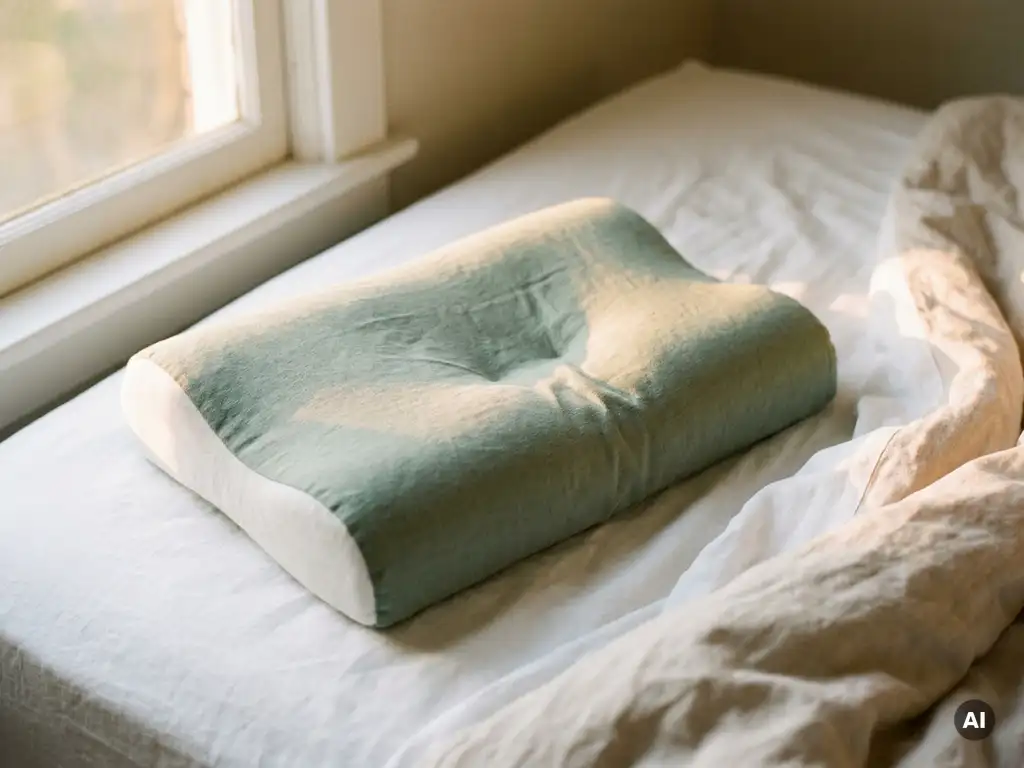
Back sleepers benefit from a medium-height pillow with a slight indentation for the head. Memory foam or an ergonomically shaped pillow adapts to the neck vertebrae and prevents the head from tilting too far forward or backward.
For side sleepers
Side sleepers need a firmer and higher pillow to bridge the distance between the shoulder and head. A pillow that collapses too quickly leaves the neck hanging at an angle. Latex or firm memory foam are good materials because they hold their shape better than traditional filling materials.
Regardless of your sleeping position: replace your pillow every one to two years, or sooner if it is visibly deformed. An old pillow that has lost its support is one of the most underestimated causes of recurring neck pain.
When is neck pain more than just a pillow issue?
Neck pain is more than a pillow issue when the symptoms persist despite a good pillow, increase rather than decrease during the day, or are accompanied by radiating pain, tingling, or loss of strength in the arms or hands. These are signals that the cause lies deeper, in the joints, nerves, or intervertebral discs of the spine.
Other signs that something more is going on:
- Neck pain that has persisted for weeks or months without improvement.
- Headaches that recur regularly and start from the neck or the back of the head.
- Limited mobility where you cannot fully turn your head.
- Pain that radiates to the shoulders, arms, or between the shoulder blades.
- Symptoms that began after a fall, whiplash, or other impact.
In these cases, a new pillow only treats the symptom, not the underlying cause. The spine and nervous system then play a central role, and targeted treatment of the source of the complaint is necessary for structural recovery.
How we help with neck pain and sleep complaints
At Ruggensteun, we look beyond your pillow. As a chiropractic practice with locations in Eindhoven and Valkenswaard, we investigate the underlying cause of your neck complaints, whether they stem from a sleeping position, a blocked vertebra, or disrupted nerve communication.
What we can do for you:
- Chiropractic examination of the cervical spine to identify blocked or misaligned vertebrae.
- Targeted treatments, including the Y-Strap technique for spinal decompression in the neck, performed by one of the few certified chiropractors in the Netherlands.
- Personalised advice on sleeping position, pillow use, and daily habits that contribute to neck complaints.
- Treatment without a referral from your GP, with free parking at both locations.
- Quick availability for acute complaints, so you don’t have to wait weeks.
Are you suffering from persistent neck pain and want to know if there is more going on than a pillow issue? make an appointment with us and we’ll look at the cause together. Would you prefer to ask a question first? get in touch via our website. We’re happy to help.
Sorry, the comment form is closed at this time.